
Mandarin · 11 September 2026
“But I Don’t Speak Mandarin.” You Can Still Support Your Child
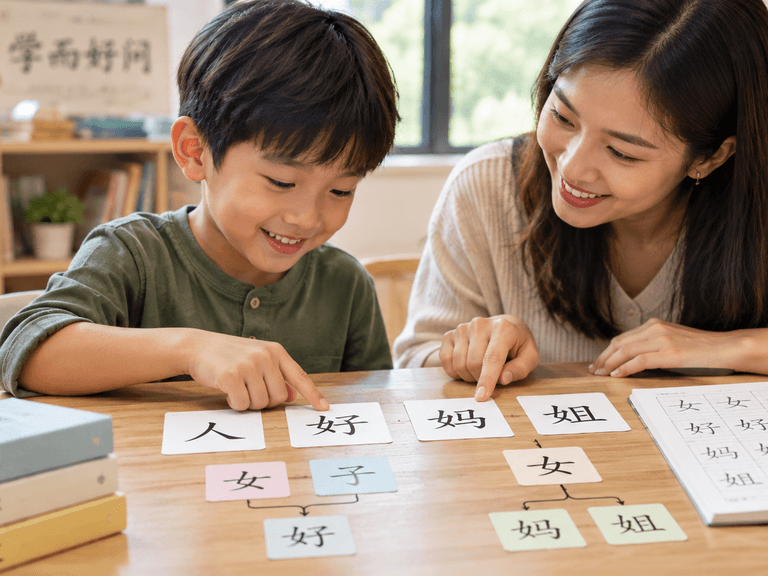
Parents do not need to become Mandarin teachers at home. Curiosity, routine and encouragement can be surprisingly powerful forms of support.
Tones are essential in Mandarin, but treating every imperfect tone as a mistake can make speaking harder than it needs to be.

By ORACLES STUDIOS ·
One of the first things Mandarin learners hear is that “tones change the meaning of a word.”
That is true.
It is also the sentence most likely to make a beginner nervous.
Mandarin uses pitch patterns as part of spoken words. The familiar example is that syllables that look identical in pinyin can have different meanings depending on their tone.
For a new learner, this can create an unfortunate habit: thinking about the tone so much that speaking stops feeling like communication.
Children usually benefit from a more practical approach.
They need to hear Mandarin often, imitate what they hear and connect sound with meaning. Songs, short dialogues, games, call-and-response activities and repeated classroom phrases give tones a real context.
Imagine learning the word 妈妈 (māma, mother). A child who hears and says it naturally in sentences is learning more than a tone mark over the letter “a.” They are learning the rhythm of a real word.
That does not mean pronunciation should be ignored. Teachers should model tones clearly and correct important misunderstandings. But correction should help a child communicate better, not convince them that they should remain silent until their pronunciation is perfect.
Even Mandarin-speaking children continue refining aspects of tone production as they develop. Language acquisition is a process.
A useful goal for beginners is therefore not “never make a tonal mistake.”
It is:
Listen carefully. Try it. Notice the difference. Try again.
Confidence and accuracy can grow together.
When students become comfortable hearing tonal contrasts and are willing to speak, teachers have something much more valuable to work with than perfect silence.
Mandarin · 11 September 2026
Parents do not need to become Mandarin teachers at home. Curiosity, routine and encouragement can be surprisingly powerful forms of support.

Mandarin · 11 September 2026
A Chinese character may look like a complicated drawing at first. With experience, learners begin to see components, positions and recurring clues instead.

Mandarin · 11 September 2026
Language grows through repeated contact. A small amount of Mandarin several times a week can be more useful than leaving everything for one marathon study session.