

Education · 11 September 2026
Group Work Is Not Automatically Collaborative Learning
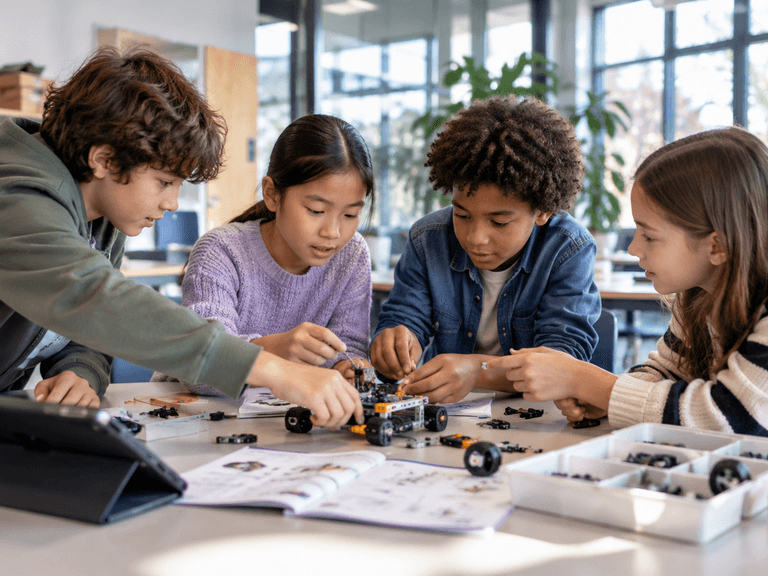
Putting four children at one table creates a group. It does not guarantee that they are learning together.
Children become more independent learners when they learn to notice how they think, plan, check and adjust.

By ORACLES STUDIOS ·
A child says:
“I understand.”
Maybe they do.
Maybe the page simply looks familiar.
Learning improves when students gain tools to check the difference.
This is part of metacognition: thinking about and managing one's own learning.
The Education Endowment Foundation describes effective metacognitive learning as involving skills such as planning, monitoring and evaluating.
Those words sound academic.
In a classroom they can be very simple.
Before a task:
During the task:
Afterwards:
Teachers can model this by thinking aloud.
Instead of simply solving a problem, the teacher says:
“I know I need to find X, but this information is distracting. I'm going to underline the two facts I actually need.”
Students hear the thinking that experts usually perform silently.
Parents can do something similar without turning homework into another lesson.
Ask:
The goal is not to withhold help when a child truly needs it.
It is to avoid doing all the thinking on their behalf.
Independence does not begin when adults disappear.
It begins when children gradually acquire the questions adults used to ask for them.
Education · 11 September 2026
Putting four children at one table creates a group. It does not guarantee that they are learning together.

Education · 11 September 2026
The most useful feedback helps a learner see the next move.
Education · 11 September 2026
Cramming can make tomorrow's test feel easier. Spaced practice is designed for the week, month and year after that.