

Education · 11 September 2026
Good Feedback Does More Than Say What Went Wrong
The most useful feedback helps a learner see the next move.
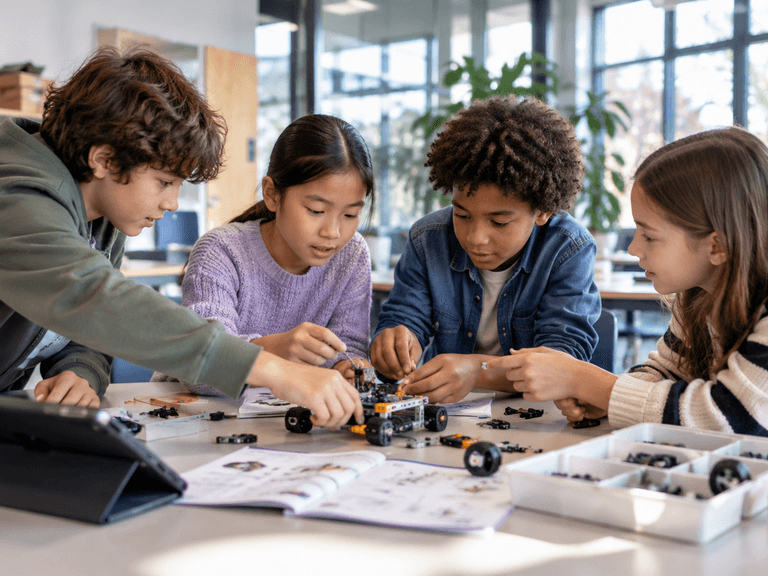
Putting four children at one table creates a group. It does not guarantee that they are learning together.

By ORACLES STUDIOS ·
Every teacher has seen it.
Four students receive a group project.
One student takes control.
One makes the presentation look nice.
One occasionally agrees.
One disappears socially while remaining physically at the table.
Technically, they worked in a group.
Educationally, very little collaboration may have happened.
Evidence reviewed by the Education Endowment Foundation suggests collaborative learning can be useful, but the work needs to be deliberately structured.
Everyone needs a reason to participate.
That might mean roles.
Or a task where each person holds part of the information required to solve the larger problem.
Students also need to learn how to collaborate.
These are teachable skills.
Good collaborative learning is therefore not the teacher stepping away and hoping children figure it out.
It requires thoughtful task design, expectations and monitoring.
The same principle matters in schools, after-school classes and learning centres: being in a group is not enough; the learning itself needs structure.
When it works, students do something powerful.
They explain their thinking aloud.
And the moment we try to explain an idea to somebody else, we often discover whether we truly understand it.
A group becomes educationally valuable not because several children are sitting together.
It becomes valuable when their thinking meets.
Education · 11 September 2026
The most useful feedback helps a learner see the next move.

Education · 11 September 2026
Children become more independent learners when they learn to notice how they think, plan, check and adjust.
Education · 11 September 2026
Cramming can make tomorrow's test feel easier. Spaced practice is designed for the week, month and year after that.